
Georgia Parole Release Authority
The State Board of Pardons and Paroles decides parole for eligible Georgia prisoners. Its public home page links to the Inmate TPM Lookup and Parolee Database. The first tool concerns a person still moving through parole consideration. The second concerns a person already released on parole. Neither is a substitute for a Pierce County jail booking or court disposition.
A Pierce County arrest may lead to several paths. Bond, dismissal, time served, or probation can end local jail custody without any Board action. A sentence to GDC shifts the search to state records. Only then do parole eligibility, a Tentative Parole Month, a grant, denial, or parolee record become relevant.
| Question | Correct source |
|---|---|
| Still in Pierce County Jail? | County current roster |
| Sentenced to state custody? | GDC offender search |
| Under parole consideration? | Inmate TPM Lookup |
| Already on parole? | Parolee Search and DCS |
| Why did the local case end? | Pierce County court file |
Confirm a Pierce Parole Release
Begin with the GDC offender search to confirm the person became a state offender. Match the name, age, GDC identifier, case clues, status, and facility. A person shown in a state facility has not been released from GDC, even if the Pierce County roster no longer lists that person.
- Confirm the state sentence and the exact person through GDC.
- Use the Inmate TPM Lookup for parole consideration.
- Read a TPM as tentative, not as a guaranteed release date.
- Use the Parolee Search after release on parole.
- Check DCS Waycross for Pierce County field-office routing.
- Request official records when online entries conflict or lack context.
The Pierce County release search covers the separate county, state, court, VINE, and federal paths. Do not force a county bond-out into the parole route.
Georgia TPM and PIC Meaning
Georgia uses Tentative Parole Month, or TPM, rather than treating every displayed month as a projected release date. The Board’s TPM explanation says the month is not a final decision. At final review, the Board may set a release date if the conditions for release are met. Conduct, programming, new information, and other case facts can alter the outcome.
Performance Incentive Credit, called PIC, can affect the timing of an eligible state prisoner’s TPM or Maximum Release Date. The Board’s decision guidelines describe the span between the PIC date and TPM as the possible advance tied to good performance. Misconduct or poor progress can delay or defeat that result. A maximum release date is also not the same as a Board grant.
- TPM
- A tentative month for final parole review, not a promise of release.
- PIC
- Performance-based credit that may advance an eligible release milestone.
- MRD
- The maximum release date shown in the state sentence calculation.
- Detainer
- A request by another authority that can cause transfer instead of community release.
Georgia Parole Decision Records
The Board can set a TPM, deny parole, reconsider a prior decision, or change a decision before release. Life-sentence cases use grant-or-deny decisions rather than ordinary TPM guidelines. A grant may be withdrawn before its effective date. The Board can also parole a person to a detainer, which means conditional transfer to another authority rather than release into the community.
These distinctions matter for Pierce County release verification. A Board entry should be paired with the GDC custody record and, after release, the parolee record. The Waycross DCS office supplies the local supervision context. If another agency filed a detainer, use that receiving authority’s locator or records office to learn whether custody continued.
The successful Board home page capture shows the state’s official parole tool entry:

The page routes users to Board records, but it does not replace identity matching or written confirmation from the agency that created the decision.
Pierce Parole Eligibility Limits
The Board says most parole-eligible prisoners are statutorily eligible after serving one-third of a prison sentence, but eligibility does not mean parole will be granted. Few receive parole at the first eligible point. Offense type, sentence terms, crime date, institutional conduct, and Board judgment all matter.
Georgia also identifies categories that are not parole eligible. The Board’s parole process discusses certain serious violent felony sentences for crimes on or after January 1, 1995, qualifying recidivist sentences, and life without parole. Life-sentence eligibility for specified serious offenses changes by offense date. Those rules should never be simplified into a universal percentage.
A Pierce County misdemeanor jail sentence does not use state-prison parole calculations. Likewise, probation set by a court is not parole. Check the actual judgment before using a state eligibility rule.
Georgia Board Meeting Notices
The Board does not publish one fixed annual hearing calendar in the researched sources. It posts monthly meeting notices, agendas, cancellations, and other public updates through Board press releases. Examples in the source material show that a monthly meeting may be scheduled and another may be canceled. Never assume a meeting will occur merely because a month has begun.
Meeting notices are not individual release lists. They help track public Board business and procedural changes. Individual status still belongs in the TPM or parolee tool. A family member following a Pierce County state case should check the person-specific tool and current Board notices separately.
The captured notices page illustrates the changing public schedule:
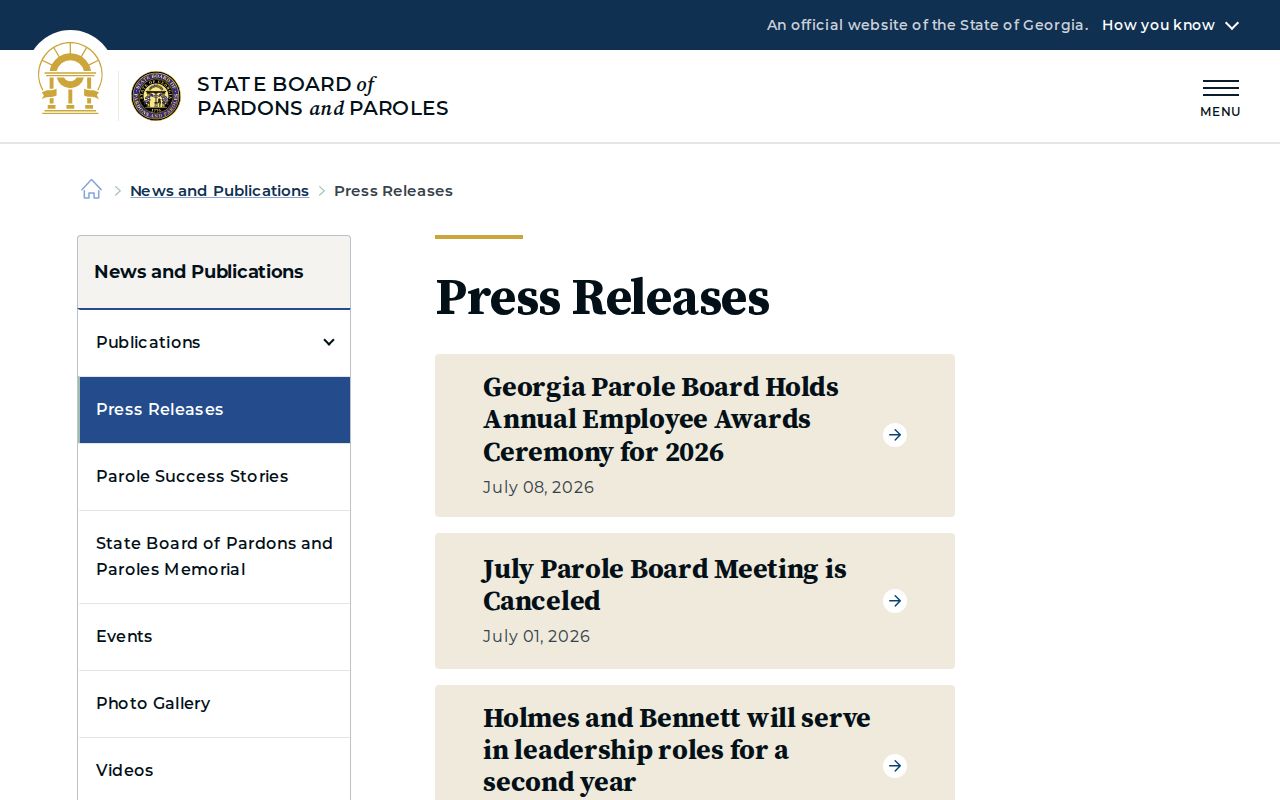
Because notices can change, the current Board page is more dependable than an older copied date.
Pierce Parole Supervision Handoff
Once parole takes effect, DCS handles field supervision. Pierce County is served by the Waycross DCS Field Office. This division of responsibility is essential: the Board decides parole, GDC carries out the state custody release, and DCS manages reporting in the community.
A parolee entry confirms a form of post-release supervision. It does not necessarily state the date the person left Pierce County Jail, because the local jail departure may have been an earlier transfer to GDC. For a full timeline, compare the Pierce booking and court disposition with the GDC, Board, and DCS records.
Sentence expiration with no parole tail may produce no active parolee record. Probation alone also belongs with the court and DCS, not the Board. A missing Board result therefore needs context and does not, by itself, prove release or discharge.
Parole discharge is a later event. Release ends prison confinement under the grant, while discharge ends parole supervision. Read those dates separately. Preserve the GDC number, court case number, sentence dates, and Board notice when requesting an older decision. Those identifiers connect the correct person to the correct state sentence and reduce mistaken matches.
Public Record Search
Sponsored Results