
Georgia Registry After Release
The GBI is the central repository for Georgia's Violent Sexual Offender Registry under O.C.G.A. § 42-1-12. The GBI registry information page explains the state system and links to its public search. Registration follows a qualifying conviction and statutory duty. It does not arise merely because someone was booked into or released from Pierce County Jail.
This system answers a narrow question: does the official registry return a matching person with an active public record? It does not state every jail stay, prove a recent release, or replace a court judgment. A registry entry may show facts about identity, conviction, residence, work, school, and registration status. Those facts come from a separate legal and reporting process.
| Record system | What it establishes |
|---|---|
| Georgia registry | Public registration information for a qualifying registrant |
| Pierce County Jail | Local booking, custody, and release information |
| Pierce County court | Charge, conviction, sentence, and disposition |
| GDC offender search | Georgia state-prison custody and release path |
| Georgia VINE | Custody status and alerts for covered agencies |
Search Georgia Registry Records
Use the official Georgia public registry search as the primary source. Search with enough detail to avoid confusing people who share a name. Read the result's identifying data and jurisdiction before treating it as a Pierce County match. A photograph is one clue, not the sole basis for identification.
- Open the GBI public registry search from the official state page.
- Choose the search method offered by the current interface.
- Enter the person's name or relevant Pierce County location details.
- Compare name, photo, physical descriptors, and other identifiers.
- Read the listed residence, work, school, offense, and status fields in context.
- Check the record's update information and responsible jurisdiction.
- Contact the listed authority when a current address or status is time-sensitive.
A no-result screen is not proof that someone was never arrested, convicted, jailed, or released. The person may have no qualifying duty, may be registered elsewhere, may be recorded differently, or may have a status that is not resolved by a simple name query. Use the Pierce County court file for conviction and sentence proof.
Georgia Registry Record Fields
The GBI research describes the registry as tied to residence, work, school, and statutory registration status. The public result can also use names, a photograph, physical descriptors, qualifying offense information, and jurisdiction details to distinguish records. Availability and labels can change, so read the live state result rather than relying on a copied profile.
| Field | What it can tell you |
|---|---|
| Name and aliases | Which identity the registry associates with the record |
| Photograph and descriptors | Clues for separating similar names |
| Residence | The address information reported in the registry system |
| Work or school | Other locations tied to statutory reporting |
| Offense information | The qualifying conviction context, not a new accusation |
| Status and jurisdiction | The agency and registration context shown at that time |
GBI states that registry information is provided by other agencies, changes frequently, and is not guaranteed accurate. That warning makes direct verification important. A stale address should not be treated as a present fact, and a map pin should not be used as a substitute for the text record.
Pierce County Registry Route
The research identifies a Pierce County local sex offender index as a county-focused view that repeats GCIC and GBI's repository role. The official state portal remains the stronger primary source for the registry record. Start with GBI, then use a local law-enforcement contact only to resolve a current Pierce County reporting question.
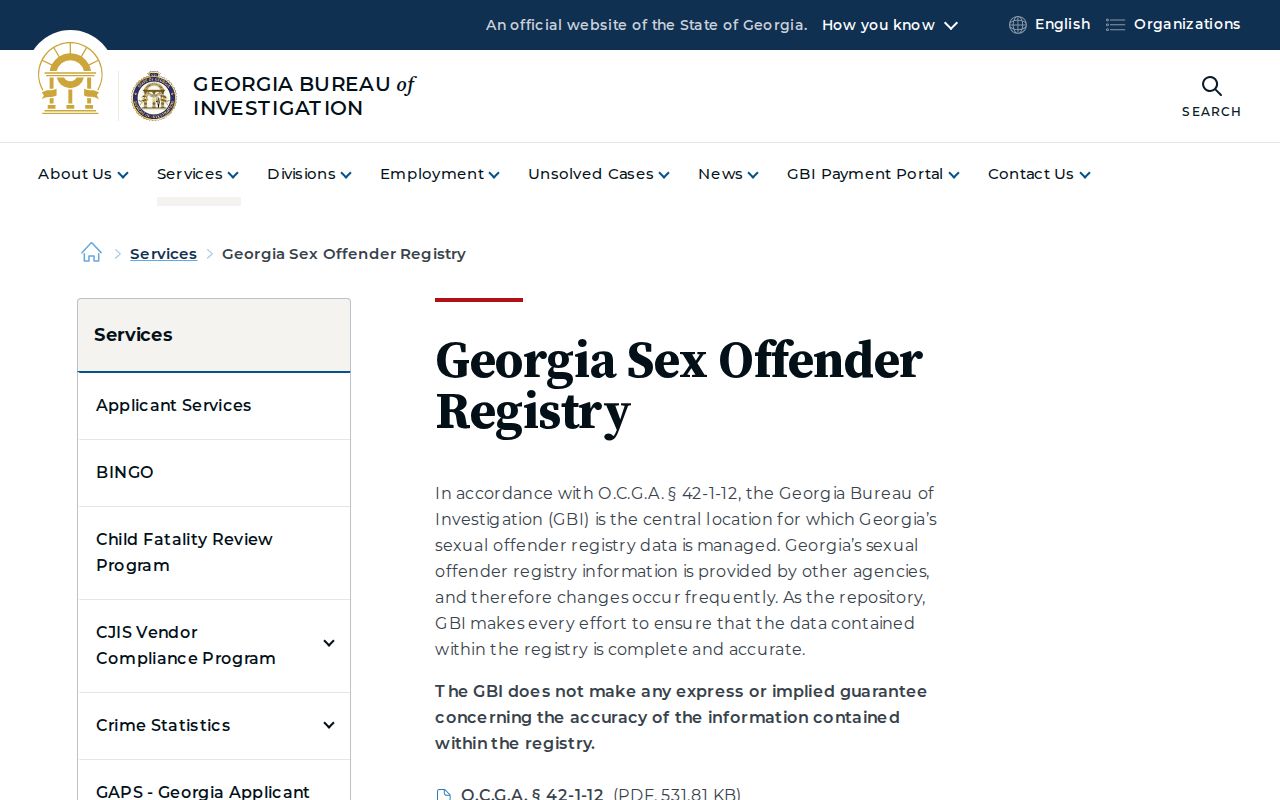
The captured GBI registry service page explains the state repository and its public search route.
If the question is whether someone just left Pierce County Jail, use the sheriff release record, booking-date history, court file, or Georgia VINE. The registry may provide post-release context only when a qualifying registration duty applies. It cannot supply the local release time or release reason.
A Pierce County registry match can persist long after custody ends because registration and detention are separate legal systems.
Georgia Registry and Court Proof
A court judgment is the best source for the conviction and sentence that underlie a duty. The registry summarizes public registration data but is not the complete criminal case. Pierce County Superior, State, and Juvenile court routes differ, and some records have access limits. Match the court, case number, and disposition before connecting a registry record to a local booking.
The jail roster can show charge descriptions, but a booking charge is an allegation and not a conviction. A registry offense reflects the qualifying conviction context reported to the repository. These must not be merged. If the names or dates conflict, consult the clerk and registry authority rather than selecting the version that seems most convenient.
- Booking
- A recorded admission to jail that does not prove guilt.
- Conviction
- A court outcome that may create statutory consequences.
- Registration
- A separate reporting duty arising under applicable law.
- Custody
- Physical detention by a jail, prison, or other authority.
- Release
- Departure from a particular custodian, possibly to another authority.
Georgia Registry Accuracy Checks
First confirm identity. Common names, old photographs, aliases, and similar dates can create mistaken matches. Compare several independent identifiers and note the responsible jurisdiction. Second, check recency. GBI cautions that data changes frequently. Third, confirm the legal event through the court when the conviction or sentence matters.
Do not infer current danger, a new offense, or a new release from the mere presence of a registry entry. Do not infer that an absent name has no criminal or custody history. The registry's function is defined by registration law, and its public fields must be used within that scope. For a current custody question, check the system that actually holds the person.
If an entry appears wrong, save the exact official URL, note the date checked, and contact the authority identified by the state record. A third-party copy may lag corrections and should not be used to override the official page.
Georgia Registry Status vs Release
A person released from GDC may move to parole or other supervision and also have a registration duty. Those statuses can overlap, but none substitutes for another. GDC controls state-prison release records. The State Board of Pardons and Paroles controls parole decisions. DCS handles felony field supervision. GBI maintains the central registry. Pierce County court records establish the local case outcome.
Likewise, a person can be transferred from Pierce County Jail to GDC while appearing in registry results. That person has left the local jail but may still be incarcerated. Read the current GDC status before describing the person as released into the community. If federal or immigration custody follows, use the responsible federal locator instead.
The Pierce County release search path maps these separate systems. Use it when the registry does not answer the actual question. The shortest accurate method is to identify the custody type first, then search the record owner for that event.
Georgia Registry Access Limits
Not every related record is public. Juvenile, sealed, restricted, investigative, medical, and protected information can have access limits. Georgia record restriction under O.C.G.A. § 35-3-37 affects qualifying criminal-history records through a separate process. It should not be described as an automatic deletion of every court, jail, or registry record.
A user who needs an official interpretation should contact the agency or seek qualified legal guidance. This page can identify the public source and explain the boundary between registry and custody, but it cannot determine whether an individual has complied with a duty or qualifies for a change in public access.
Public Record Search
Sponsored Results