
Pierce County Court Release Proof
A court record is not a jail release log. It records the case and the judge's actions. That distinction makes the file useful after a released person disappears from the current Pierce County Jail roster. The Pierce County courts portal separates local court offices and provides the county route for finding the right one.
The docket may explain whether bond was set, posted, changed, revoked, or forfeited. It may show that a charge was dismissed, nolle prossed, bound over, indicted, resolved by plea, tried, or otherwise disposed. A sentencing entry may reflect jail, probation, a split sentence, state prison, or credit for time served. The jail still controls its own release timestamp. Read the court outcome beside the custody record rather than substituting one for the other.
| Question | Best record |
|---|---|
| When did local custody end? | Pierce County Jail release record |
| Why did a judge authorize release? | Order, bond entry, or docket |
| How did the charge end? | Disposition and judgment |
| Did state prison follow? | Sentence plus GDC status |
| Did felony supervision follow? | Sentence, DCS, or parole record |
Search Pierce County Court Records
Begin with the court listed in the expanded jail charge detail, if available. Pierce County's roster can identify the court along with warrant number, counts, statute, description, and offense type. Those details help the clerk distinguish people with similar names and connect the booking to the correct case.
- Write down the full name, booking date, charge, warrant number, and named court.
- Use the county court portal to identify the office responsible for that court.
- Search an available case portal with the name and case details.
- Match the filing, charge, and dates before reading a disposition.
- Review bond, orders, judgment, sentence, probation, and later warrant entries.
- Contact the clerk if the case is missing, incomplete, sealed, or unavailable online.
- Confirm the physical release time with the sheriff when timing matters.
The statewide e-access route can redirect users to a provider and may require an account. Participating counties do not all expose the same material. Pierce County research does not support a promise that every criminal case can be searched online without charge, so the clerk remains the authoritative fallback.
Pierce County Clerk Contact
The GSCCCA Pierce County clerk listing identifies Melissa A. Howard as Clerk of Superior Court and lists Superior, State, and Juvenile courts under the office. It gives a street and mailing address, telephone number, and weekday public hours. The county's general court contact is separate, so send the request to the court that holds the case.
3550 Hwy 84
PO Box 588
Blackshear, GA 31516
(912) 449-2020
Monday-Friday, 9:00 a.m.-5:00 p.m.
The county court page also lists 312 Nichols Street, Blackshear, GA 31516, and 912-449-2022 as a court contact route. Before visiting, confirm which location holds the file and whether the office's current public hours differ. Ask for an existing docket, order, judgment, or disposition by case number when possible. A narrow request is easier to route than a request for every record linked to a name.
For a release question, identify the person, approximate arrest date, booking charge, and court. Request the public bond entry, release order, disposition, sentence, probation order, or revocation entry that answers the question. A clerk may withhold sealed, restricted, juvenile, or otherwise protected material.
Pierce County Court Structure
Different courts answer different parts of a case. The county page identifies State, Superior, and Probate Court sections, while the clerk listing covers Superior, State, and Juvenile courts. Magistrate or municipal proceedings may also matter depending on the charge and first appearance. Do not assume that the Superior Court clerk holds every record simply because it is the most visible listing.
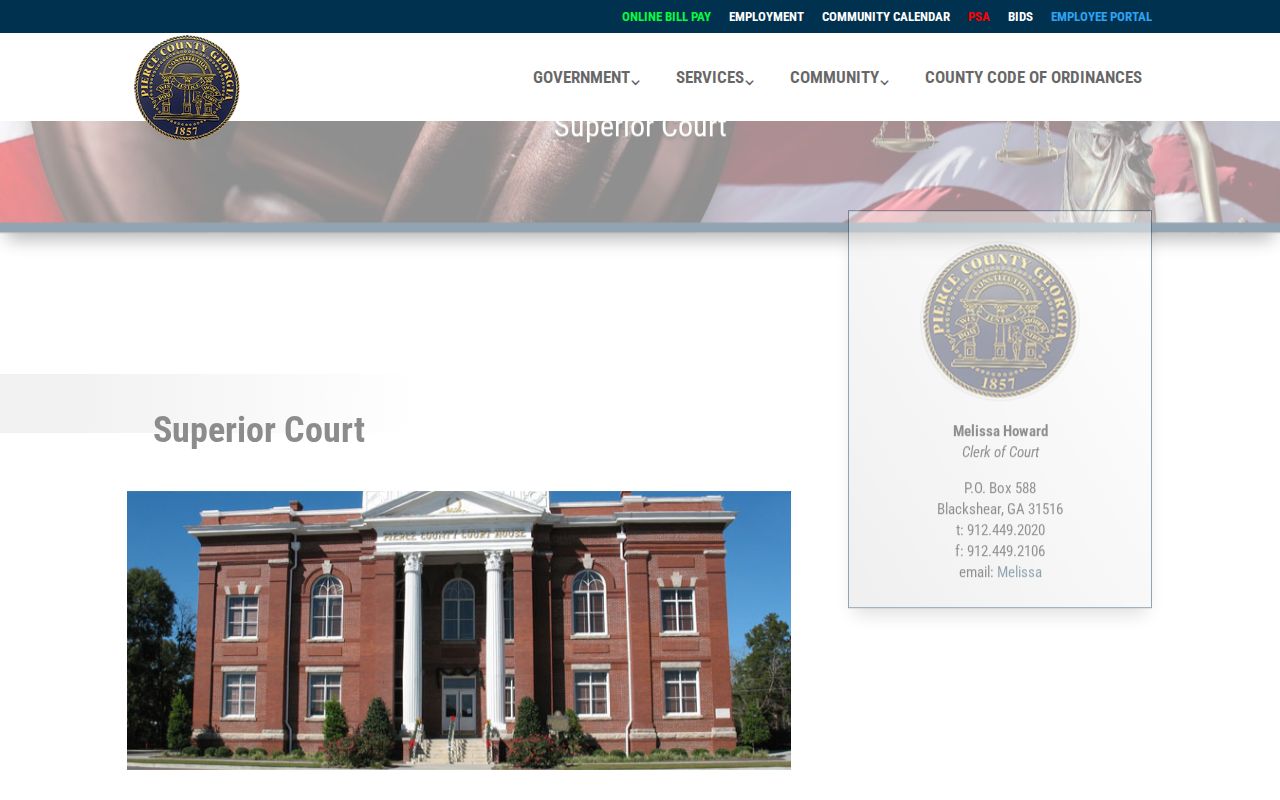
The captured Pierce County Superior Court page shows the local office route and current court information.
A case can also move. A charge may begin in a lower court and later be bound over or indicted in Superior Court. Search the later case when an early docket ends without a final disposition. Juvenile matters have added access limits, and a public site should not imply that those records are generally open.
Pierce County Bond and Sentencing
Bond data must be read with care. A roster's total bond field shows a listed amount, not proof that payment occurred or release followed. The court file may show conditions, modification, revocation, or forfeiture. Sheriff records then show the custody event. When the two dates differ, processing, another hold, or a transfer may explain the gap.
A sentence of time served can allow release after the jail calculates credit and receives the order. A probation sentence can release a person to community supervision without any state-prison stay. A split sentence can combine confinement and probation. A state-prison sentence sends the person into GDC, so departure from Pierce County Jail is a transfer. The Georgia DOC state release page explains that later state path.
- Bond
- A court-set condition for pretrial release, not proof that custody ended.
- Disposition
- The recorded outcome of a charge or case.
- Time served
- A sentence recognizing qualifying confinement already spent.
- Split sentence
- A sentence combining confinement with a period of probation.
- Transfer
- Departure from one custodian while custody continues elsewhere.
Pierce County Records After Release
Georgia record restriction can change what remains broadly available. GBI explains that O.C.G.A. § 35-3-37 governs restriction of qualifying criminal-history records. For arrests after July 1, 2013, GBI directs the person to the prosecutor rather than a GBI application. For older arrests, the process begins through the arresting agency. Eligibility depends on the facts and outcome, so a missing public result should not be explained by guesswork.
A restricted criminal-history entry, a sealed filing, and a jail release record are not identical things. Some agency or court records may remain while public access to other information changes. The court or custodian can state what is available and identify the legal basis for withholding. Georgia Legal Services Program has a Waycross location noted in the research for civil legal navigation, but that listing does not promise assistance or a particular outcome.
Court records can outlast a roster entry, yet sealed, juvenile, and restricted material may not be open to the public.
Pierce County Release Cross-Check
Use three records when the stakes of accuracy are high. First, the jail record gives booking and local release facts. Second, the court docket explains bond, disposition, sentence, or an order. Third, the receiving system shows whether custody continued. GDC covers state prisoners, DCS covers felony supervision, the Parole Board covers parole decisions, BOP covers federal custody, and ICE covers its own detention path.
A name missing from the current roster proves only that the person is not displayed there. It does not prove community release, dismissal, or sentence completion. A court sentence to GDC, a detainer, or a later warrant can change the interpretation. Match identifiers and dates across the records, then confirm inconsistencies with the office that created the contested entry.
Public Record Search
Sponsored Results